Pleo Specifications: Inside the Robot Dinosaur
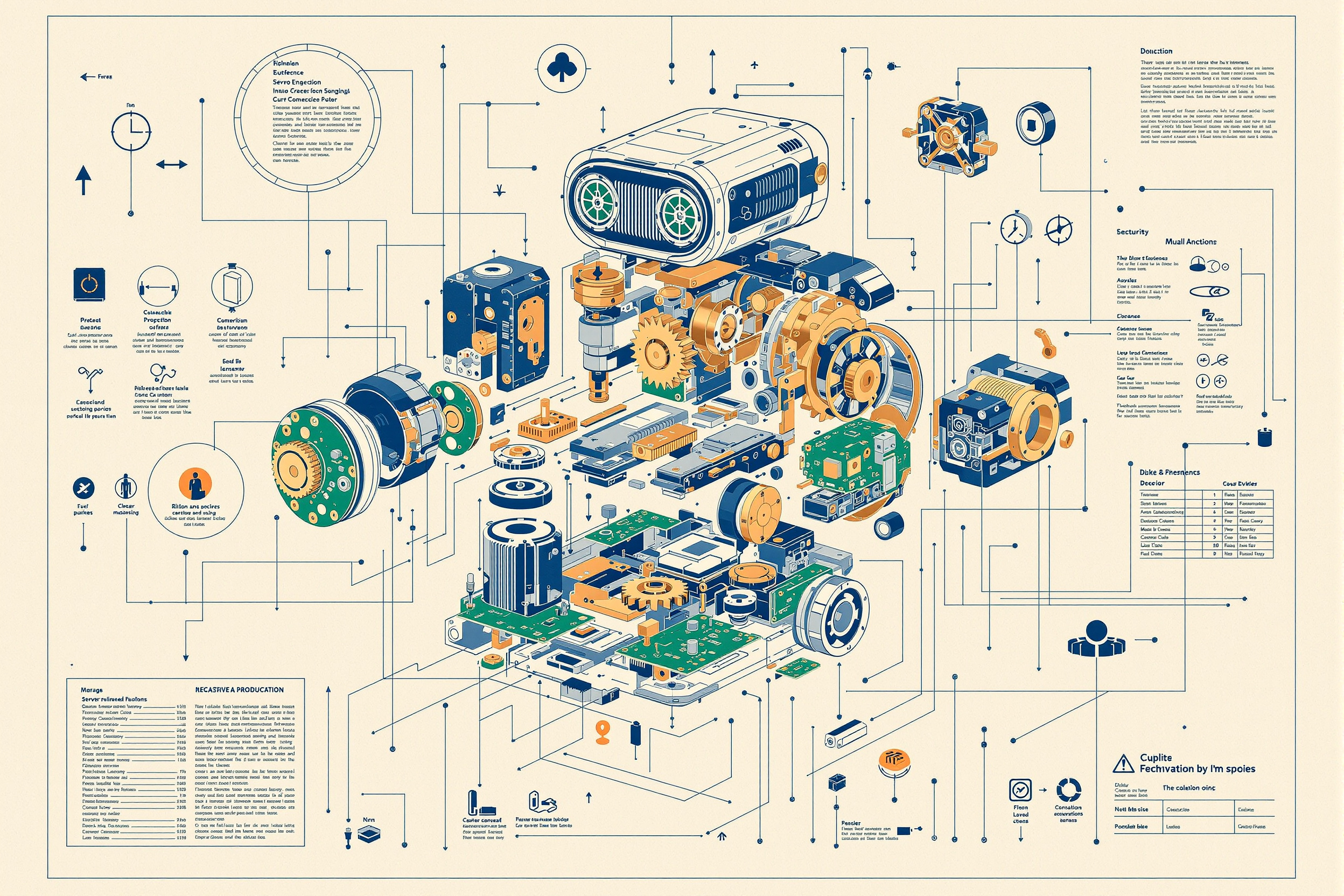
Pleo's warmth came from cold engineering: motors, sensors, and software working in concert to fake a heartbeat. Here is what sat beneath the skin of the original Ugobe Pleo, and how the pieces combined to produce a creature that felt alive.
Movement and Motors
Pleo moved with roughly fourteen servo motors driving his neck, legs, tail, jaw, and eyelids. The articulation was expressive by design — he could crane his neck, stretch, cock his head, splay his toes, and blink — the small gestures that read as "alive." Crucially, his makers chose metal gears rather than cheaper plastic ones. Metal cost more and delayed the product, but it made Pleo noticeably quieter, so his movements whirred softly instead of grinding. Anyone who saw an early unit remarked on how hushed and smooth he was compared with other robots of the day.
The Sensor Suite
Pleo's behavior was only as convincing as his senses, and here he was genuinely ahead of his class. He shipped with an unusually rich sensor array — dozens of individual sensors feeding his behavior engine:
- Nose camera — a camera in his snout used to sense light, edges, and his surroundings for navigation. Contrary to a popular rumor of the day, it did not recognize faces (more on that in our nose camera note).
- Capacitive touch sensors — spread across his head, back, chin, and body so he could feel where he was being petted or handled and respond accordingly.
- Tilt and orientation sensing — so he knew when he was picked up, tipped, cradled, or turned over.
- Foot/ground sensors — detecting contact with a surface, informing his footing and gait so he could tell floor from air.
- Microphones — for sound and beat detection; a Pleo could bob and react to a rhythm.
- Infrared — used for detecting and communicating with other Pleos (see herd behavior) and for sensing objects close to his mouth, such as his feeding leaf.
The Life OS Brain
All of that sensing fed the Life OS, the software layer that turned raw inputs into moods and actions. Rather than firing pre-set animations, Life OS blended competing drives — curiosity, comfort, fatigue, sociability — to choose what Pleo did next. It's what allowed the same dinosaur to seem playful one minute and sleepy the next, and to develop differently depending on how he was treated. His makers spoke of Life OS as a reusable platform, an "operating system for life" that could in principle animate future creatures beyond a single dinosaur. You can read more about that adaptive temperament on the What Is Pleo? page.
Made to Be Programmed: The Pawn Language
For the technically inclined, Pleo was hackable in an approachable way. Ugobe exposed his behavior through Pawn, a small, purpose-built scripting language. Pawn deliberately hid the "nasty and treacherous" low-level details of the robot and let hobbyists write new behaviors — changing sounds, reactions, and tricks — without needing to master the whole Life OS. That decision mattered: it meant a far larger group of owners could tinker, and it seeded an enthusiastic modding community that shared custom Pleo scripts other owners could load and enjoy. Few consumer robots of the era were so openly invited to be reprogrammed.
Power and Physical Design
Pleo ran on a replaceable rechargeable battery pack rated for roughly a two-to-three-year service life, giving about two to four hours of active play before he needed to nap and recharge. His skin was a soft, sculpted covering designed to suggest the muscle and bone beneath — and, famously, to develop a gentle wear pattern with petting over time. At roughly the size of a small newborn animal, he was substantial enough to feel like a real pet in your hands but light enough for a child to carry. Full battery and skin-care guidance lives on the care page. For a concise reference summary of all of the above, the encyclopedia's Pleo overview is a good companion to this page.